
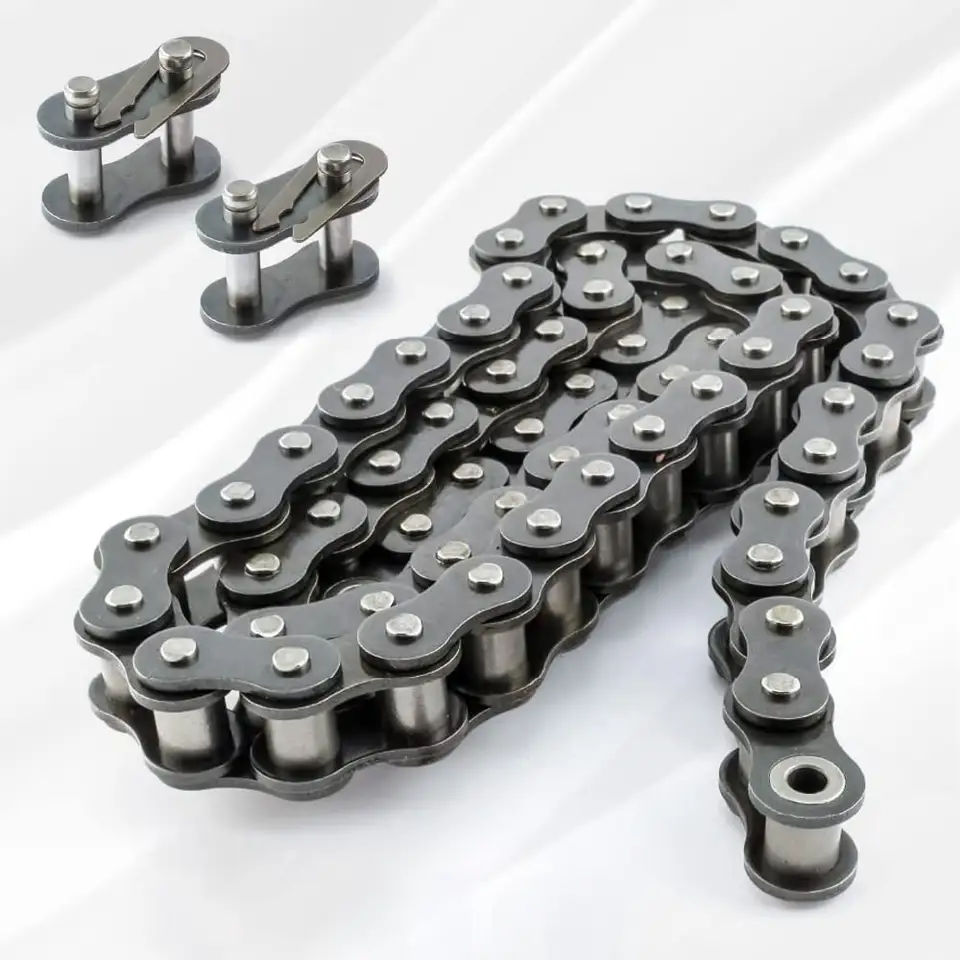
Product Description
1) A series chains:
A) Simplex: 25-1 ~ 240-1
B) Duplex: 25-2 ~ 240-2
C) Triplex: 35-3 ~ 240-3
D) Quadruplex: 40-4 ~ 240-4
E) Quintuple: 40-5 ~ 240-5
F) Sextuple: 40-6 ~ 240-6
G) Octuple: 40-8 ~ 240-8
2) B series chains:
A) Simplex: 04B-1 ~ 48B-1
B) Duplex: 04B-2 ~ 48B-2
C) Triplex: 06B-3 ~ 48B-3
D) Quadruplex: 08B-4 ~ 48B-4
E) Quintuple: 08B-5 ~ 48B-5
F) Sextuple: 08B-6 ~ 48B-6
G) Octuple: 08B-8 ~ 48B-8
3) Colors available: Natural, yellow, blue, black
4) Materials: Alloy, Carbon steel, stainless steel
/* January 22, 2571 19:08:37 */!function(){function s(e,r){var a,o={};try{e&&e.split(“,”).forEach(function(e,t){e&&(a=e.match(/(.*?):(.*)$/))&&1
| Usage: | Transmission Chain |
|---|---|
| Material: | Alloy |
| Surface Treatment: | Polishing |
| Feature: | Heat Resistant |
| Chain Size: | 1/2"*11/128" |
| Structure: | Roller Chain |
| Customization: |
Available
| Customized Request |
|---|
How do roller chains handle dusty or dirty environments?
Roller chains are designed to operate effectively in various environments, including dusty or dirty conditions. Here’s a detailed answer to the question:
1. Sealed Construction: Many roller chains feature a sealed construction, which helps to protect the internal components from dust, dirt, and other contaminants. The seals help to prevent the entry of particles into the chain’s joints and lubrication areas, reducing the risk of wear and damage caused by abrasive particles.
2. Proper Lubrication: Adequate lubrication is crucial in dusty or dirty environments. The lubricant forms a protective film on the chain’s surfaces, reducing friction and wear. It also helps to flush away and prevent the accumulation of dirt and particles. Regular lubrication maintenance is necessary to ensure the chain remains properly lubricated and protected.
3. Periodic Cleaning: In dusty or dirty environments, it is important to periodically clean the roller chain to remove accumulated debris. This can be done using compressed air or gentle brushing. Care should be taken not to use excessive force or abrasive materials that could damage the chain.
4. Proper Chain Covering: In some applications, it may be necessary to use chain covers or guards to provide additional protection against dust and debris. These covers help to shield the chain from direct exposure to contaminants, reducing the risk of accelerated wear and damage.
5. Regular Inspection: Regular visual inspection of the roller chain is essential in dusty or dirty environments. This allows for the early detection of any signs of wear, corrosion, or contamination. If any issues are identified, appropriate maintenance or replacement should be performed promptly.
It’s important to note that even with these measures, roller chains used in dusty or dirty environments will still require proper maintenance and periodic cleaning. Following manufacturer recommendations for lubrication, cleaning, and inspection will help ensure the longevity and reliable performance of the roller chain in such conditions.
What are the limitations of using roller chains in certain applications?
Roller chains are versatile and widely used in various applications, but they do have some limitations to consider. Here’s a detailed answer to the question:
1. Speed Limitations: Roller chains have a practical speed limit due to factors such as chain length, centrifugal forces, and roller-to-sprocket engagement. At high speeds, the centrifugal forces can cause excessive chain vibration and increase wear, potentially leading to chain failure. In such cases, alternative power transmission systems like gears or belts may be more suitable.
2. Precision Requirements: Roller chains require proper alignment and tensioning for efficient operation. In applications that demand high precision, such as precision machinery or robotics, the inherent flexibility and slight elongation of roller chains may not meet the desired accuracy requirements. In such cases, alternative systems like timing belts or direct drive solutions may be preferred.
3. Environmental Limitations: Roller chains may not be suitable for certain environments with extreme temperatures, corrosive substances, or high levels of contamination. Harsh conditions can accelerate chain wear, reduce lubrication effectiveness, or cause corrosion. In these situations, specialized chains with appropriate coatings or alternative power transmission systems may be necessary.
4. Noise and Vibration: Roller chains can generate noise and vibrations during operation, particularly when not properly tensioned or maintained. In applications where noise or vibration is a concern, such as in noise-sensitive environments or precision machinery, additional measures like chain tensioners, vibration dampening, or alternative drive systems may be required.
5. Size and Space Constraints: Roller chains have a certain physical size and require appropriate clearance for installation. In applications with limited space or tight packaging requirements, alternative power transmission systems like compact belts or direct drives might be more suitable.
It’s important to carefully evaluate the specific requirements and constraints of each application when considering the use of roller chains. Alternative power transmission systems may be more suitable in certain cases, and consulting with experts or manufacturers can help determine the best solution for the intended application.


editor by CX 2024-04-29